Posts

Reflection: Quinn

Image
The New Gods of the Anthropocene This summer, I had the privilege to visit the Redwood forest of Big Basin Redwoods State Park. Within Big Basin lies one of the oldest preserved stands of old growth Redwoods, some trees are even older than the Roman Empire . It was one of the most beautiful places that I’ve ever been.  Big Basin pre-CZU Fire There was a moment while I was hiking, when my boyfriend and I decided to be completely silent. We stopped and listened to the forest. Redwoods are so tall, that the life in the canopy is almost silent to those on the ground. In the crowns of the forest, there is an entire ecosystem. On the forest floor, it is almost unnoticeable. Ferns grew perfectly framed by little triangles of sun that made it through the forest, and a thick carpet of loam covered all the walking trails.  A couple of weeks after I left Big Basin, I began ‘Religion in the Anthropocene’, a class which has ultimately expanded my view of God, as well as helped me to unders...

The God Species Evolves: Mori Art Museum’s “Future & the Arts: AI, Robotics, Cities, Life”

Image
The direction in which the whole of humanity currently seems to be headed towards isn’t that of prosperity or growth, but perhaps the pressure of unavoidable consequences is what is needed in order to envision and erect a new world; both a return to nature and the returning of nature. We are, as some Anthropocene theorists have put it, the newly revealed god species capable of choosing our planetary destiny. The exhibition Future and the Arts: AI, Robotics, Cities, Life - How Humanity Will Live Tomorrow which ran from November of 2019 through to March of 2020 at the Mori Art Museum in Tokyo attempts to give context to the unimaginable and proposes solutions to the issues of now and those of the future.  Future of the Arts included 64 participants with over 100 works from across the globe, ranging across mediums, processes, design phases, and content. The exhibition was divided into five sections, two of which were most impactful in visualizing our imminent future. The first of th...

Seeing Through the Illusions of Capitalism: The "Diamond Sutra"

Image
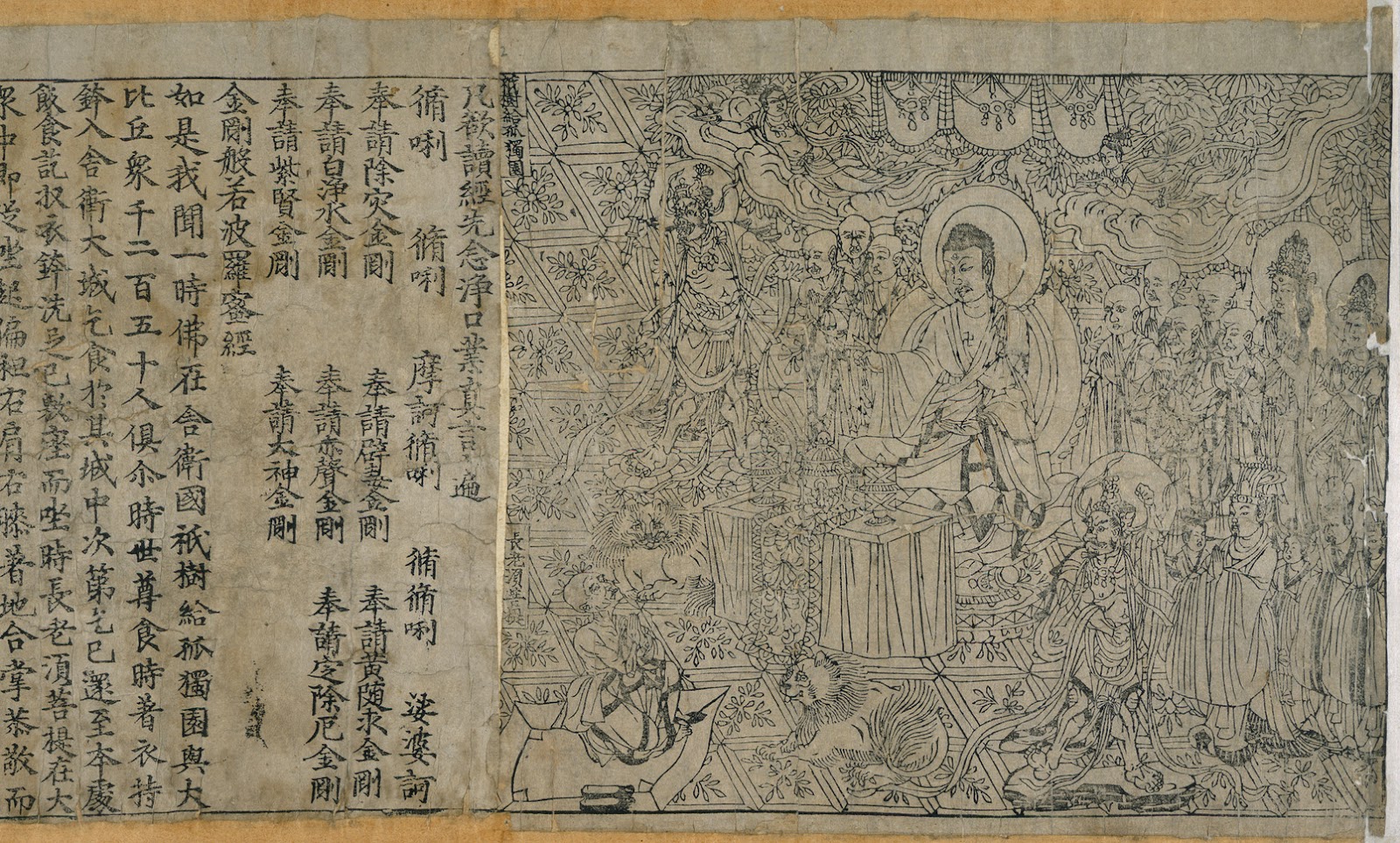
  After reading the Bhagavad Gita with great interest, I started reading another ancient scripture, the Buddhist scripture called the Diamond Sutra . It’s one of the most important texts of the Mahayana school of Buddhism, the most influential branch of Buddhism in China. I tried reading the version of the Diamond Sutra in ancient Chinese, translated from Sanskrit in the 400s and had quite a lot of trouble breaking down the ancient phrases. A recent introduction, Jingangjing Shuo Shenme (which translates to What the Diamond Sutra Discusses About), helped me begin to understand the Sutra. I think that out of all the schools of philosophy from different religions across the globe, that contained in the Diamond Sutra may be some of the most relevant to the era of the Anthropocene. The Anthropocene (perhaps better described as Capitalocene) shows the fatal consequences of a wrong understanding of the relationship of self and world. The Diamond Sutra offers many useful ideas for cor...

The Environmentalist’s Tools: "An Ecomoderist Manifesto" and Beyond

Image
  The Breakthrough Institute is a research center based in the Bay Area of California devoted to finding “technological solutions to environmental and human development challenges.” It supports efforts to curb climate change through the implementation of advanced technologies and the rapid modernization of developing countries. Members of the Breakthrough Institute are frustrated by the underutilization of life-saving technologies such as affordable nuclear power, genetic modification in agriculture, and water desalination in the places where they are most needed. “ An Ecomodernist Manifesto ” (2015) is a short outline of the Institute’s philosophy co-authored by 18 of its members who span fields from economics to documentary filmmaking.  “An Ecomodernist Manifesto” is divided into seven sections that each grapple with an element of “ecomodernism.” For the sake of brevity, I will try to summarize each section succinctly but it is essential to note that much detail will be lost...

Anthropocene Discourse in Latin America: Astrid Ulloa on the Displacement of Politics and Human/Non-Human Inequalities

Image
  Astrid Ulloa gave a talk in March 2020 entitled, “ Anthropocene and Capitalocene in Latin America: Rethinking anthropocentrism or displacing politics and inequalities between humans and non-humans .” The lecture was given as part of the international conference, “Living on the Edge: Studying Conviviality - Inequality in Uncertain Times” in Sao Paulo, Brazil. It was posted on YouTube by the channel Mecila Merian Center on May 12, 2020. The talk focused mainly on the growth of anthropocene studies over the last few years and its slow adoption by academics in Latin America. She states that in the last five years the conversation surrounding the Anthropocene has changed completely in that participants have belatedly begun to make more room for countries in the global south and people of color. Ulloa comments that when she began to attend conferences on the Anthropocene five years ago, there were only two participants from Latin America and only two conferences which discussed indige...

Religion as Anthropocene Externality? Steven D. Levitt & Stephen J. Dubner’s "SuperFreakonomics"

Image
  Steven D. Levitt and Stephen J. Dubner’s Freakonomics (2005) and SuperFreakonomics (2009) don’t explicitly address the anthropocene, but their analysis of the climate movement as a religion resonates provocatively with our class discussions. Levitt is an American economist currently working as the William B. Ogden Distinguished Service Professor of Economics at the University of Chicago, he is also the Faculty Director and Co-Founder of the Center for Radical Innovation for Social Change. He was co-editor of the Journal of Political Economy as well as the co-founder of a business and philanthropy consulting company. In 2006, after the release of Freakonomics , he was featured as one of Time magazine’s “100 people Who Shape Our World.” Dubner is an award-winning author and journalist. Best known for his works with Levitt he has also released several other books, including, Turbulent Souls/Choosing My Religion (1998), and Confessions of a Hero-Worshipper (2003). Coming from ...

Will Rama Save Us From Evil Once Again?

Image
Fabrice Monteiro’s The Prophecy is extremely striking and dynamic in its subject matter and composition. He uses a strong palette to create contrast in the different textures. This artistic manifestation of the destruction that industrialization and capitalism have brought is extremely compelling and powerful. It is important to note that "these sites were chosen precisely because they are neither unique nor remote; these are places where Senegalese people go about their daily lives, impacting the water they drink, the fruits and vegetables they eat." This allows the viewers to experience the daily lives of Senegalians. The photographs highlight the environmental damage,overwhelming mass destruction and emphasize the global inequality of the climate crisis.Therefore, these photos illustrate how we are not only destroying the natural world, but the natural world will soon reclaim our spirits and bodies.  Now let's look at the Hindu figure: Ravana. Ravana was one of the m...

An Emerging Utopía: La Colonia, Nueva Oportunidad

Image
Set in the university garden of La Facultad de Bellas Artes in Madrid, New Opportunity-The Colony , is an ephemeral agro-ecological artist community that radically reinvents and challenges the boundaries between art, aesthetics, agriculture, and social ecology, creating a space for the synergy of diverse knowledge and communal living practices, and nurturing a profound trust in creative power.  This project is one of many manifestations by artist and agroecology activist Fernando Garcia-Dory. The Colony, through exemplary living practices, encourages the importance of kinesthetic learning and radical pedagogy by experimenting with self-organization, sociology, and collective agency that is inspired by spiritually and ideologically based intentional communities.  In a global climate of scarcity and socio-ecological turbulence, The Colony dares to introduce a new ethic. They’ve modeled a space that fosters aesthetic contemplation for ecological revitalization. Not only does the...

Crochet Coral Reef: Crochet Climate Change

Image
Crochet Coral Reef (2005-present) and the Satellite Reef program are ongoing pieces by sisters Margaret and Christine Wertheim, the reef contributors, and participants. Their socially engaged art piece builds community through collaboration and education. The Institute for Figuring (IFF) is a non-profit organization founded by the sisters and combines education on complex abstract thought with collaborative projects and tactile play. Crochet Coral Reef is broken down into three sections: climate change, plastic trash, and the midden. The main reef, crocheted by the Wertheims and the reef contributors, travels to museums and galleries around the world. The reef is constructed of wool and found plastic trash and objects.  Crochet Coral Reef brings attention to climate change and its devastating effect on coral reefs. The “reefs” crocheted range from healthy corals to bleached ones. Toxic Reef and Bleached Reef are two of the bleached reef pieces that are a part of the core reef, t...

OM-let: Andy Weir's "The Egg"

Image
    Andy Weir is an American novelist, focusing primarily on science fiction and speculative sci-fi. He is the author of four books, including The Martian (2014), which was adapted into a movie by Ridley Scott in 2015. With a background in mechanical sciences and computer programming, his writing is often characterized by an in-depth exploration of the mathematics behind the concepts he explores. This is in stark contrast to one of his most prominent works, a short story released in 2009 called “ The Egg .” With almost no scientific bearing, “The Egg” is best described as a religious or philosophical query into how life is connected, and what those connections mean.  The plot of “The Egg” follows a man who has just died in a car crash. The Egg is written in the second person, and the person addressing the reader turns out to be God, who explains the reader’s death. Naturally, you (the reader) inquire about the nature of life, what will happen to your loved ...